January - 1 articles
March - 1 articles
May - 2 articles
February - 3 articles
May - 2 articles
June - 4 articles
July - 1 articles
August - 1 articles
September - 1 articles
November - 1 articles
December - 3 articles
February - 2 articles
March - 1 articles
April - 3 articles
May - 3 articles
June - 7 articles
August - 3 articles
October - 3 articles
November - 2 articles
February - 1 articles
March - 1 articles
April - 2 articles
May - 4 articles
June - 2 articles
August - 5 articles
September - 4 articles
October - 6 articles
December - 2 articles
January - 1 articles
February - 2 articles
March - 1 articles
April - 10 articles
May - 3 articles
June - 5 articles
July - 1 articles
August - 3 articles
September - 2 articles
October - 5 articles
November - 1 articles
December - 5 articles
December - 1 articles
Date: 20th October 2010
Delegates from 29 countries are in Edinburgh this week to discuss Dryports – an innovation that could revolutionise the future of international freight in Scotland.
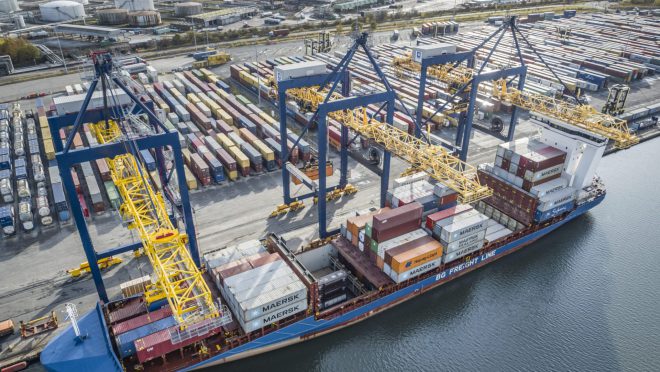
Dryports are Intermodal freight terminals located inland to serve a specific industrial or commercial region.
Directly connected by rail to one or more seaports, they act primarily as extensions to those seaports, thereby increasing their capacity and efficiency.
For Scotland, Dryports offer a range of benefits. Currently underused port facilities can be brought back into greater use, as freight is redirected from road to sea, reviving communities, creating jobs and boosting the local economy. Extending existing rail links to link port facilities with Dryports can become economically viable, while traffic congestion and pollution are reduced.
SEStran Chair, Cllr Russell Imrie said:
“This is a major first for Scotland. Over 130 academics and industry professionals from all over the world are in the capital, to participate in the UK’s first ever Dryport Conference, at the Balmoral Hotel.
“A crucial function of Dryports is to encourage modal shift away from road transportation to more environmentally sustainable sea and rail options. As the nation’s highways become increasingly clogged with traffic, finding ways of reducing the number of lorries rumbling through our towns and cities; and the consequent rise in greenhouse emissions, has become an urgent necessity”.
“Integrated working between Scotland, our European partners and the wider world is a crucial factor in our future as a global trading nation. The Dryport conference and our participation in the £5.5. million EU-funded Dryport Project, which is developing the concept within Europe, puts Scotland firmly on the cutting edge of developments in global freight distribution”.
Dr. Gordon Wilmsmeier of TRI added:
“Discussing and understanding the importance and role of inland multimodal terminals like Coatbridge, Scotland’s international trade flows and the need for integrated port development are crucial for making future informed decisions in industry and the public sector”.
“In Scotland, we need answers to questions like ; why is the majority of Scotland’s international trade transported in an unsustainable manner and; why does it continue to be moved by road and not through Scottish ports?”
“The dialogue and knowledge exchange at the Dryport Conference between leading academics in the field of maritime transport and intermodal freight transport and people involved in the industry offers a unique chance for all participants to get a global perspective on state of the art concepts and strategies that integrate ports and their hinterlands.”
ENDS
SEStran - South East of Scotland Transport Partnership - is one of seven new Statutory Regional Transport Partnerships (RTP) created by the Transport (Scotland) Act 2005 and is a partnership of eight local councils covering the Borders, Clackmannanshire, East Lothian Midlothian and West Lothian, Edinburgh, Falkirk and Fife.
For further information, please contact:
Andrew Dougal, SEStran Communications Officer
T: 0131-524-5161
M: 07889-010-291
E: Andrew.dougal@sestran.gov.uk
Notes