
SEStran Press Releases
News Archive

Date: 22nd April 2009

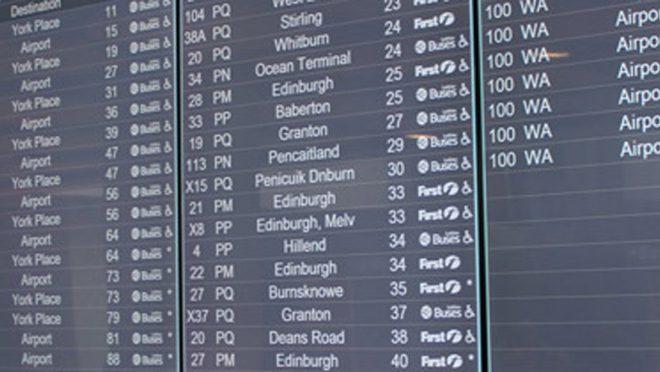
SEStran has succeeded in obtaining European funding to deliver Real Time Bus Passenger Information Systems into rural areas of South East Scotland.

On Friday, First Minister Alex Salmond announced £95 million of European Structural Funding for 129 projects under Round Two of the 2007 - 2013 Lowlands and Uplands Scotland Programme. Over £600,000 has been awarded to SEStran, to roll out the first stage of the Real Time Bus Passenger Information Project in the Borders and East Lothian.

Together with match funding from the two local councils and SEStran, the money will be used to deliver Real Time Bus Passenger Information into rural areas where bus services may be infrequent or intermittent.

SEStran Chair, Cllr Russell Imrie said:

“Real Time Bus Passenger Information Systems are among the most immediately and obviously useful innovations in transport information provision. By providing constant updates on arrival times for bus services, they put the travelling public back in control of their journeys”.

“The passenger knows how long the wait will be; whether they have time to go and buy the newspaper, or make that telephone call; whether they are running late, or in time for appointments. Like most good ideas, it’s very simple, but extremely useful”.

“By extending real time throughout the region, SEStran is making good on the commitment outlined in our Regional Transport Strategy (RTS), that everyone living in the region should have access to the highest possible quality of service”. 

ENDS

SEStran - South East of Scotland Transport Partnership - is one of seven new Statutory Regional Transport Partnerships (RTP) created by the Transport (Scotland) Act 2005 and is a partnership of eight local councils covering the Borders, East Lothian, Midlothian and West Lothian, Edinburgh, Fife, Falkirk and Clackmannanshire.

For further information, please contact:

Andrew Dougal, SEStran Communications Officer

T: 0131-524-5161

M: 07889-010-291

E: Andrew.dougal@sestran.gov.uk

Notes :

1. Benefits of RTPI

Accurate RTPI creates a step-change in the perception of public  transport and is particularly useful in rural areas where services are less frequent.  

The project specifically targets education and employment areas and will complement existing initiatives, such as green travel planning. In addition, RTPI provides long-term, wider benefits for East Lothian and Scottish Borders as it improves access to public transport for all users.  

The project will also provide benefits at a strategic level. Within the “before and after” study, post code data from education & business partners will be analysed to assess how well existing bus services serve existing commuting trips.

If gaps or opportunities are identified, efforts will be made to improve services to employment & business by modifying existing routes or implementing new community transport initiatives, possibly through a further ERDF application. Fleet management tools in the RTPI system allow bus operators to manage their services better in real-time.   

2. Contribution to existing Scottish Executive strategies

In feedback summaries, Scotland’s National Transport Strategy (Chapter 5) recorded that “we should do more to improve the passenger experience of bus services” and “Irregular and unreliable bus services are a big problem…”. The strategy stated that “information is key to continuing to grow passenger numbers” (para. 201) and recognised the benefits of real time passenger information in a Dundee Case Study. (para 226). 

The proposed RTPI project will improve the passenger experience in East Lothian and Scottish Borders. It will improve the quality of information, build user confidence and remove the uncertainty associated with unreliable services. The proposed project will improve safety for both passengers and bus drivers. The web / sms / mobile web facilities mean that passengers can make intelligent decisions about when to leave for the bus stop, minimising the amount of time spent waiting on-street thereby reducing any actual or perceived risk. This is particularly beneficial for vulnerable groups or lone travellers, especially during the hours of darkness.  

In addition, on-bus security is enhanced as the system provides a voice radio system which provides 2-way communication between the driver and the control centre in the event of an emergency. In extreme cases, such as an assault, the driver can press an emergency button which immediately triggers an alarm in the control centre. The system then automatically displays the exact location of the vehicle on a map on the control centre computer work-station and opens voice communication with the vehicle.  

The national transport strategy seeks to “promote improvement in the overall accessibility of the transport network for older and disabled people and those with limited mobility” (para 215). The proposed RTPI system includes the RNIB React audio announcement system making the on-street signs accessible to blind and partially sighted users. Many elderly travellers with impaired vision are, however, not formally registered with the RNIB and do not have access to the RNIB service. To address this, the audio announcements can also be triggered using the Scottish Concessionary Travel Card, issued to all pensioners and other selected groups living in Scotland. Touching the card against a card reader at the sign will announce the next bus departures from the stop.  

3. Contribution to SEStran Regional Transport Strategy 2008 – 2023.

The project supports:  

·         Travel Behaviour / Smarter Choices (Para 6.2) – through improved quality and dissemination of passenger information. 

·         Public Transport Information (Para 6.13.4) – “RTI is seen as an essential component supporting the overall quality of service”. A pilot of new routes and corridors is acknowledged as a “medium to high priority for SEStran.” (Para 6.13.5) 

·         Mobility Impaired Transport Information Services (Para 6.14.6) – regarding such services, the RTS states that “it is appropriate to consider roll-out on a corridor basis, in tandem with other improvements, including RTI.” The proposed project does exactly this. 

 ·         In a SEStran Regional Transport Strategy policy context (RTS Appendix C), the proposed project supports Policies 1, 2, 6, 7, 13, 17, 19, 26, 36. (Further explanation is included in the Annex.)  

To access a copy of the SEStran Regional Transport Strategy, please visit  www.sestran.,gov.uk